Case study · Tarmac thickness survey
69 mm of tarmac missing, found before the surface course went on
A new adoptable estate road for a national housebuilder. The survey showed the base and binder well under thickness. A core taken where the survey said 116 mm came back within 3 mm of it. Too thin to regulate, a 25 m length had to come out. Caught at binder stage, that is a remedial job for the contractors responsible. Caught at adoption, the surface course comes out with it.
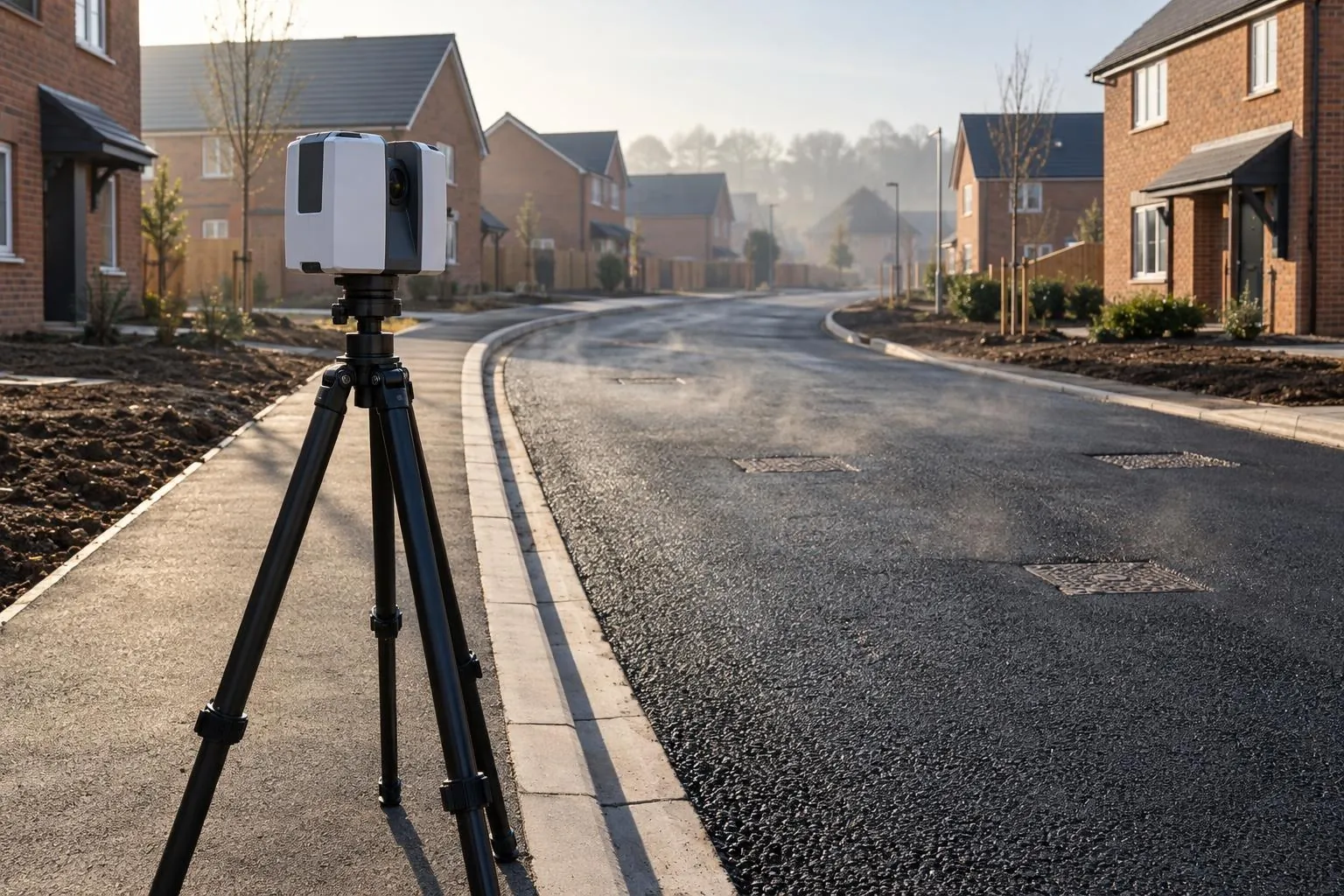
In short: a Dimensure thickness survey of a 180 m estate road found the base and binder laid an average of 173 mm against a 198 mm target, and 116 mm against 185 mm at one point on the centre line. A core at that point matched the survey to within 3 mm. The worst 25 m was too thin to regulate and had to be taken out and relaid. Found at binder stage, that is remedial work for the contractors responsible. Found at adoption, after the surface course, it would likely have cost about £23,000.
The road
A 180 m adoptable access road, 5.5 m wide, on a residential development for a national housebuilder, with a raised table part way along. The design called for 185 mm of bound base and binder, with 125 mm on the table and a sacrificial binder layer over the first 100 m.
What we did
We surveyed the stone before the tarmac went down and the binder once it was laid, both on the same site control, then took one from the other to give the thickness laid along every survey line: both channels and the centre line. The thickness was checked against the design build-up, chainage by chainage, and reported with a plain summary on page one.
What we found
The road was thin almost everywhere. Of the 30 points where both surveys were close enough to give a reliable thickness, 27 were under the target. The average was 173 mm against a 198 mm average target, and at chainage 150 on the centre line it was 116 mm against 185 mm: 69 mm, or more than a third, missing.
Across the road, about 26.6 m³ of bound material was net short, roughly 63 tonnes. The report split it by cause: about 17.5 m³ where the tarmac was laid low, and about 9.1 m³ where the stone underneath was laid high, leaving less room for the tarmac.
The numbers
- Road
- 180 m x 5.5 m
- Client
- National housebuilder
- Service
- Tarmac depth survey
- Average laid
- 173 mm (target 198 mm)
- Worst centre line
- 116 mm (design 185 mm)
- Net short
- 26.6 m³ (about 63 t)
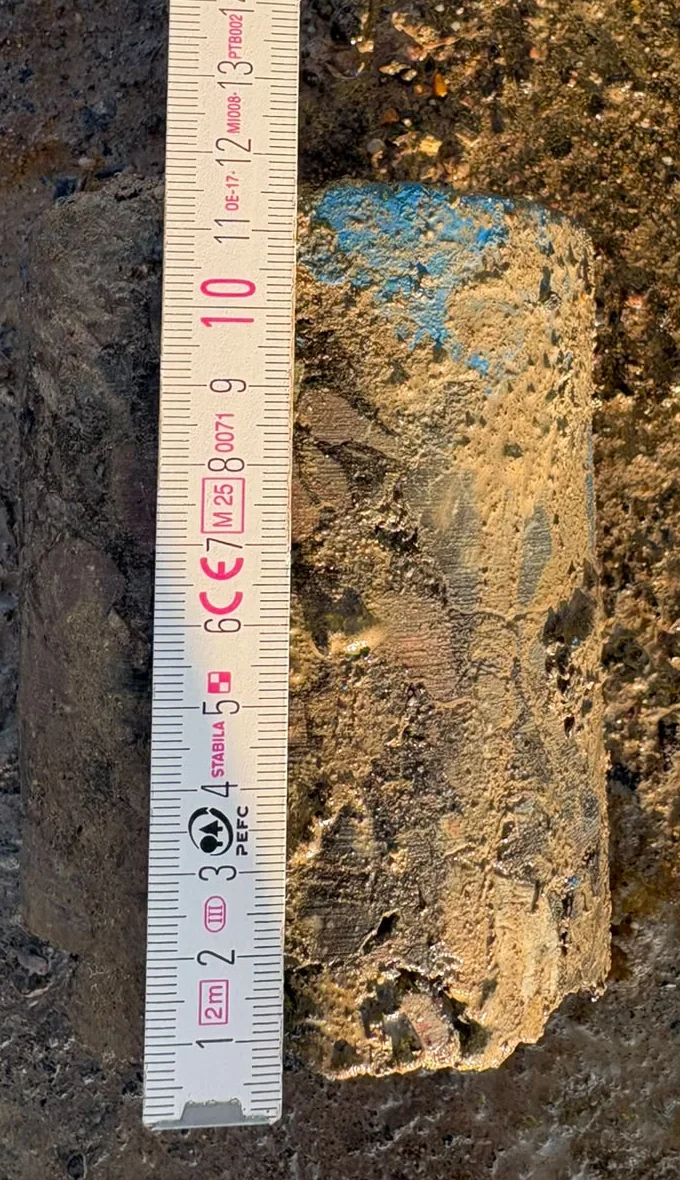
The core from chainage 150, centre line.
The proof: one core, within 3 mm
A survey is only worth acting on if people trust it. So a core was taken on the centre line at chainage 150, where the survey showed 116 mm.
- Designbound layers
- SurveyDimensure
- Corecut on site
The core came back within 3 mm of the survey. That one hole confirms what the survey shows for the rest of the road, and the survey shows where any further cores are worth taking, instead of guessing.
What finding it now is worth
Thin tarmac doesn't show on the surface. It shows when the adopting authority cores the road, by which time the surface course is down.
| Found at | What putting it right looks like | Potential cost |
|---|---|---|
| At binder stage (what happened) | 25 m x 5 m (about 125 m²) of base and binder taken out and relaid to the required standard by the contractors responsible. Too thin to regulate: an overlay has to be at least about 2.5 times its aggregate size | No cost to the client |
| At adoption, after the surface course | Day 1, break out: traffic management (£1,500), saw-cut edges (£480), plane out 225 mm through all bound layers (£2,500), haul away about 66 t (£1,400) and tip or recycle it (£990). Days 2 and 3, relay in three lifts: surfacing gang, paver and roller (£5,000), about 54 t base and binder (£4,590) and 12 t surface course (£1,140), part-load deliveries (£600), bond coat and sealing (£500), ironwork reset (£800), supervision and proving cores (£700). Contractor overheads and margin at 15% (£3,030) | About £23,000 |
| The survey | Stone and binder surveyed, thickness reported against design | Under £1,000 |
How the figures are worked out: area to come out 25 m x 5 m = 125 m². Old tarmac out: 125 m² x 225 mm = 28.1 m³, about 66 t at 2.35 t/m³. New tarmac: base and binder 125 m² x 185 mm = about 54 t; surface course 125 m² x 40 mm = about 12 t. Direct costs £20,200, plus 15% overheads and margin £3,030 = £23,230, shown as about £23,000 (about £186 per m²). Return = £23,000 ÷ a fee under £1,000 = over 23x. A small remedial job is priced by the day, not the tonne, because the planer and surfacing gang cost the same whatever the quantity. All costs are estimates based on typical 2026 UK rates, not quotes, and exclude VAT. They do not include delay to adoption, the bond being held for longer or the time spent resolving who pays, all of which would usually add to the total.
And compared with coring alone
To check the same 30 points by coring would cost in the region of £6,500 to £7,700 at published coring rates of £217 to £257 a core, leave 30 holes to reinstate, and still say nothing about the road between them. The survey covered every survey line on the road, and one core proved it.
Why this matters to the bottom line
Asphalt is bought by the tonne and specified by the millimetre, and a thin layer looks exactly the same as a full one from the surface. If nobody measures it before the surface course, the first anyone hears of it is a failed core at adoption: the finished road has to come up, the bond stays in place, and the argument about who pays starts after the contractors have left site.
Measured at binder stage, the same shortfall is a list of chainages, a cause for each, and a remedial job for the people responsible, done before the road is finished.
Fair to everyone on site
The report doesn't just say "thin". It separates where the stone was laid high from where the tarmac was laid low, so each shortfall sits with the right trade, and it asks about sacrificial layers and agreed departures before calling anything a fail.
What the thickness report gave the site team
- A one-page summary of findings and actions.
- Thickness at every reliable point against the design build-up, including the raised table and sacrificial layer.
- Volume and tonnage short, split by cause and by layer.
- Where to core to confirm it.
- Tolerances stated on the cover sheet.
The client, site and contractors are not named, for confidentiality. Costs are potential costs based on estimates; the length was put right at binder stage, not after the surface course.
More case studies · Tarmac depth survey prices · Road and sub-base level surveys
Questions we get asked
How do you measure tarmac thickness without coring the whole road?
By surveying the layer underneath before the tarmac goes down and the finished layer afterwards, both on the same site control. The difference between the two at any point is the thickness laid there. On this road, a single core then confirmed the survey to within 3 mm.
What happens if tarmac on an estate road is found to be too thin?
It depends how thin and when it is found. If there is room, a regulating layer can make up the difference, but a layer can only be laid at about two and a half times its aggregate size or more, so a small top-up is not an option. Where it is too thin to regulate, the tarmac has to come out and be relaid. Found before the surface course, that is remedial work for the contractors responsible. Found at adoption, the surface course comes out too, and the cost goes up.
How much does it cost to take out and relay a length of thin tarmac?
On this road, 25 m by 5 m, about 125 m², had to be removed and re-tarmacked. If it had only been found at adoption, after the surface course, our estimate is £23,230, about £23,000, or roughly £186 per m². A small remedial job like this is priced by the day, not the tonne: a day to saw-cut, plane out and cart away about 66 tonnes of old tarmac, two days for a surfacing gang to relay base, binder and surface course in three lifts, plus traffic management, ironwork, materials and the contractor's overheads. These are estimates from typical 2026 UK rates, not quotes.
Does a thickness survey replace cores?
It reduces them. The survey maps the thickness across the whole road and shows where cores are worth taking. Checking the same 30 points by coring alone would cost in the region of £6,500 to £7,700 at published coring rates, and leave 30 holes to reinstate. Whether a survey can stand in for cores at adoption is the adopting authority's decision.
Why is the cost described as potential?
Because the shortfall was found before the surface course, so the length that had to come out was taken out once, at binder stage, rather than after the road was finished. The figure is our estimate of what putting it right would likely have cost if it had been found at adoption instead.
Book a scan or ask a question
Send the drawing, the location and when you need it. We reply the same working day with a fixed price.